Tuesday, 18 November 2014

Sacred Sites on the Emerald Isle: Temair (The Hill of Tara)

Yes - long overdue. Far too long.
You may all revere my powers of procrastination. Now's grand. I accept offerings of raw cacao and tea.

All shenanigans aside, a wee while ago I went on a field trip - again with my lovely class- to the Hill of Tara (Temair in Old Irish), which features prominently in Irish tales from the Mythological Cycle, and is a site said to have been used for kingmaking.

It's also said to be the residing place of the Morrigan, who's kind of my own personal patron saint. I've been reading about her since childhood, and she's just plain badass.

Some context for kingmaking, you say?

Right - so Ancient Ireland was divided into kingdoms - lots of kingdoms. I have one lecturer who's said between 80 and 100, and another saying between 100 and 150. For the sake of this wee blog post, let's just say it's around 100. Now, each kingdom had its own "petty" king (that's 100 kings at once), but there was one king who was supreme - the "High King" or "King of Kings" - the King of Tara. This king would have participated in an elaborate ritual in order to be inaugurated, which goes something along the lines of this:

In a nutshell, the king-to-be would presumably have walked up the long straight ditch, as if he were coming out from the Earth, after which he would mount a chariot drawn by two unbroken horses that he would have to lead between two stones. Once he'd done this, he would touch the Lia Fáil (Stone of Destiny) which would then, according to myth, "cry out" if he were the rightful king. 

Now, if one has a mind prone to analysis, the themes here are blatantly sexual. One of my lecturers has compared the procession and ritual to the process of childbirth, the stone crying out in pain. Another interpretation is is more pleasurable one, in which the stone cries out in ecstasy. The visuals relatively relate to the same thing, however. Irish kings, in order to actually BE rightful kings, would *ahem* engage in sexual activity with a goddess of sovereignty, or a divine embodiment of the land. So there's your imagery. 

Anyway, no, we didn't recreate the ritual - although that would have been utterly brilliant. 
The fascinating thing with these ritual sites is that they seem to have been built with an aerial perspective in mind. This is what the site looks like, although one obviously doesn't feel that when walking on it. The only thing you feel is the wind. So much wind....
It truly is a stunning site, and what's even more impressive is the view. It doesn't look or feel it, but Tara is one of the highest points in that area, and you can see for miles. 


Thursday, 16 October 2014

Treading Ancient Ground...

So over the past few weeks, I've been an absolute glutton in terms of my classes here in Ireland. I've gorged myself on Early Irish mythology, indulged in Ancient Celtic civilization and binged on Old Irish. I'm positively intoxicated.
I've compared my Ancient Celtic Civilization lecturer to Dr. Jones Senior (Sean Connery, for the poor souls who've not seen Indiana Jones), but with Geoffrey Rush's buccaneer voice. He's an expert in his field of archaeology, and it's enchanting to be in his presence. 
My Women in Irish Myth and Irish Literary Traditions lecturer is eccentric, bubbly and refreshingly enthusiastic, and I get along incredibly well with her. The Literary Traditions class is tiny - there are only about ten of us, including her, and it can be quite easy for a question or comment to lead to the entire lecture's change of course. It's refreshingly intimate and informal, and it's lovely to be able to bounce ideas off each other all within the context of a classroom - and in the presence of an expert.  

Last week, my flatmate and I were privileged enough to participate in a field-trip to Brú na Bόinne (commonly known as Newgrange), Knowth and Dowth. All three of these Neolithic archaeological and historical sites are what are known as "passage tombs" - burial mounds likely also used for religious ceremonies. They're ancient - older than the Pyramids - and positively enchanting. 

Brú na Bόinne was massively restored between 1962 and 1975 - excessively and incorrectly so, according to my many (including my lecturers), due to the fact that the stones were cemented together, which would obviously not have been possible when the mound was originally built. But that doesn't take away from the sheer majesty of the site. Set at the top of a hill from where one can see for miles, it's difficult to grasp just how magical and significant the mound really is - until you're inside it, that is. At the entrance is a gargantuan stone, still ornate with spiral carvings that date back thousands of years. You have to crouch to get inside (a fair few people have smashed their heads), and as soon as you duck under the stone doorway, it feels as if you've been swallowed up by the Earth.  I had to stop for a moment and remind myself just how old this monument actually is. It isn't a replica, reproduction, model or imitation. It's the real thing. This passage tomb was built, decorated and used by people living in Ireland thousands of years ago, and it was exceptionally humbling to actually be there, touching the stone, breathing the air, standing where the ancient peoples would have stood. The passage stones are ornately carved, and I thought I felt a subtle climb as I ventured deeper into the mound - a suspicion which was soon confirmed by the guide we had. I entered the chamber, with its 20-foot-high domed stone slab ceiling, and couldn't resist a gasp of utter wonder. It's very difficult for us to realize just how impressive monuments like this really are - we've seen skyscrapers, cathedrals, domed ceilings and just about everything one can come up with in terms of architecture. An underground domed stone ceiling doesn't seem like very much after you've climbed the Eiffel Tower or taken the lift to the top of the Empire State. But when you take a moment to think about the technology and cleverness required to build this chamber, knowing that the ancient peoples had nothing apart from their hands with which to build it, it becomes a lot more impressive. Anyway, when we all got inside the chamber, the guide proceeded to explain a bit of the history surrounding the mound, as well as some archaeological finds (and thefts - grrz). She then came to one of the most fascinating aspects of this mound - and that is the phenomenon that takes place on and around the Winter Solstice. Just above the entrance to the mound is what appears to be a rectangular window. As the sun rises on the Solstice, it shines directly through that hole and casts a terribly bright beam of light all along the passage and into the chamber - it starts off small and slowly elongates with the rising of the sun, and proceeds to get shorter again and disappear as the sun moves higher up in the sky. The symbolism for this has long been the subject of debate among archaeologists. Some say that this phenomenon would have been incredibly spiritual for the ancient peoples, whose religion arguably revolved around the sun (which only makes sense, as the sun is largely what maintains the cycle of life), and this renewed sight of the sun's bright, life-giving light would have reassured them, confirming that yes, there would be another year of growth and fertility and food. Good times. We were lucky enough to have a demonstration of this recreated with artificial light, obviously, but impressive nonetheless. 

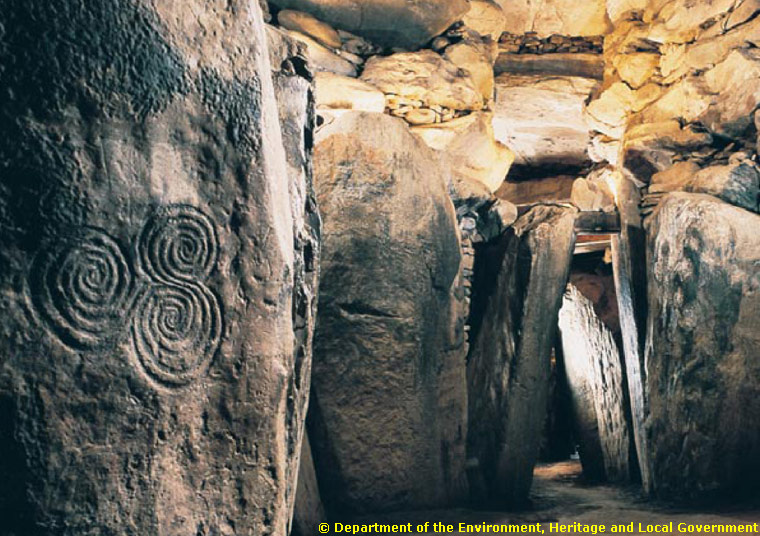
Also, for the fans of Celtic art out there - the Tri-Spiral you see everywhere? This is where the original is. Yup.

This is quite obviously not my own photograph, as picture-taking inside the monument is strictly forbidden. This picture is from the Newgrange website, so please don't sue me. Also, it's clearly written in bold, yellow Arial across the bottom of the picture. ;)
After the light demonstration, we were sent back outside so the other half of the group could come in, as we didn't all fit at once. The chamber is quite small - my lecturer estimates about ten people could move comfortably inside at a time, so when 15-20 of us tried to jam ourselves in and look around, it was a tad beyond cozy. 
My flatmate and I proceeded to walk around the monument, and yes, remove our shoes to feel the grass and earth on the soles of our feet. As my flatmate says: "It doesn't count if you didn't go barefoot". 
I really don't think this photograph requires an explanation.
 I wear rings on my toes. My flatmate doesn't. That's all you're getting. ;)


On the way to the bus, an apple in one hand and a book in the other. Classic. 

The breathtaking view from the site. The weather was glorious once again - a perfect autumn day.


Brú na Bόinne from a distance - from this far away, it honestly just looks like a mound with a wall. The important thing to remember here is that the wall probably doesn't look a thing like it used to, as it was restored/recreated. All the same stones, just probably not how they were originally placed. 


The entrance to the passage. 

This is one of the two best decorated stones, and it's protected by gates as well as two staircases for tourists to use - normally people would have to climb around the stones to get in, but they try to avoid that now. It's right at the entrance, and you can see just how massive it is by the guy standing right beside it. Amazing.  

More of the view!


This is the rock exactly opposite the entrance stone, intricately decorated and still magnificent after all these years. 


The outside of the monument. 

After Brú na Bόinne, we hopped another shuttle bus which took us to Knowth, a site not far from Newgrange consisting of multiple burial mounds of different shapes and sizes. My Ancient Celts lecturer actually gave the tour this time, so it was lovely to hear all the tales and theories straight from an expert. 


Multiple burial mounds. Almost looks like Hobbiton, but on that note, a particularly morbid Hobbiton. 


The entrance to the Knowth main burial mound. The white rocks on the ground are the same as the ones on the facade of Newgrange, but these were left intact after they fell from the mound. You can see by the entrance just how massive these mounds are. Unfortunately we couldn't take photos inside...

The stunning views!

On top of the largest mound at Knowth. 

View from the top of the mound. 

It's these photos that show off just how massive these mounds are. Unfortunately the inside is blocked and we don't have access to very much, but we used a torch to see a little ways inside - "impressive" is an understatement. 


The decorated rocks on the outside. 

A few of us crawled through this passage, with help from my lecturer's trusty torch (which was more like an epileptic seizure-inducing strobe to be honest, but meh). It was good fun, and I managed to not get muddy ;) 
After Knowth, we went to Dowth, which has been left intact in terms of restoration. It has been mutilated - some people dug into it some time ago, but apart from that there isn't much to see, which makes it all the more mysterious, knowing what is inside but being unable to actually see it with your own eyes.

 It was fascinating to be able to see all three sites consecutively in one day. Brú na Bόinne, the excessively restored, tourist-attracting mound, Knowth, the less reconstructed but still very much protected group of mounds, and Dowth, the untouched mound, whose appearance is a product of time and nothing else.
Two of my classes deal with Irish mythology and stories, and Brú na Bόinne is a very important location in more than just a few of these mythological tales. Characters are born and die here. Lovers elope here. It was an odd feeling to stand on soil that is prominently mentioned in myth - as if the mists were rising and I'd stumbled into the Otherworld. 

Thursday, 18 September 2014

Help me fund a project!

All the traveling!

Planning my adventure to Ireland sparked a particularly fierce travel itch that led me to take a semester off school after Christmas in order to continue seeing the world. That being said, I figured I'd give myself a purpose for these adventures, and I decided to apply for a volunteer abroad project. Within a week of submitting my application, I received a phone call, had an hour-long interview over the phone, and was accepted to the program!

So in March, I'll be taking the plane to Madagascar, where I'll teach English and do wildlife conservation for just under a month. 

There are no words for how excited I am. I study Teaching English as a Second Language in Montreal, and although I love it, I can't see myself conforming to the North American education system for any extended period of time. I was lucky enough to be required to teach adult immigrants during the first year of my program, and it was such an enriching experience for me. Talking with people with different native languages, different backgrounds and different views on the world made me feel like I had a patchwork quilt of stories in front of me. I believe teaching is more of an exchange of information than a one-way transmission, and my passion for people and the world in general made teaching adult immigrants an incredible learning experience. 

That being said, teaching students abroad will not only help me gain practical experience in my field, but give me a taste of what I hope to do once I've graduated (if I haven't started ten other degrees by then). Teaching in a strict school setting is not an attractive lifestyle for me, and although the security that comes with it is ideal in terms of lifelong planning, the constrictions, guidelines and curriculum restraining me would drive me insane. Teaching English is a one-way ticket to the entire world, and the entire world is just waiting for me to see and experience it.

So, yes, come March, I'll be teaching English in Madagascar - but (this is where things get weird) I need to fund this incredible project of mine.

At the end of August I opened a small shop on Etsy, to give me some motivation to indulge in another hobby of mine which combines gemology and jewelry making. Here be the link to said shop: https://www.etsy.com/ca/shop/EarthboundAdornment?ref=si_shop
Do have a look if you're interested. The stones I use are hand picked by a world-class gemologist, who has become a dear friend of mine and who has taught me so very much (not only about gems).

So in the end, it'll be another exchange - you won't get nothing for helping me fund my project. Wow...I'm reaching. Sorry.

In November I'll also be opening a Fund My Travel campaign, so if you know anyone who enjoys giving money away at Christmas time, send them my way!

So, a huge thank-you in advance to anyone who checks out my creations, and for putting up with my shenanigans in the first place. 'Tis greatly appreciated! ^_^

If you or anyone you know is interested, this is the program I will be working with:
http://www.frontiergap.com/
They're a really lovely team of people and they have beautiful projects all over the world - if you're looking for something to get involved in, I highly recommend them!

Hakuna matata as always!
xxx

Céad Míle Fáilte!

Orientation week began yesterday at Maynooth University for the International and ERASMUS students. It's been fairly low-key, actually - for me, anyway. But in that respect, my entire life is low-key, because I make it happen that way.
The list of classes I want to take is flat out ridiculous, and I'm honestly considering returning to Ireland to actually finish the degree in Early Irish and Medieval Celtic Studies, because let's be honest - it's got my name written all over it in big, bold, stinky red Sharpie. For the curious, some of the classes include The Ancient Celts, Early Irish Myths and Sagas, The Celtic Heroic Age, Old Irish, Middle Welsh Grammar and Readings (*drool*), Basic Medieval Latin and Ireland Encounters Scandinavia.
That should give you an idea of what I'm getting myself into here. 
I'll be auditing more than just a few of these....

Anyway, back to the beginning here. Something stood out quite prominently to me during the talks and welcome speeches and guided tours, and it began when the president of the University stood up to formally welcome us internationals to his school: he began speaking Irish. 
Now, to most (if not all) international students, he was speaking utter gibberish - this is where I have to extend a massive heartfelt go raibh maith agat to my Irish professor Seaghan, who is the best language teacher I've ever had - because yes, I understood most of what he was saying. But that's not what made me smile. You see, during my Irish lessons over the past year, I learned much about the status of the Irish language in Ireland, and it isn't as well thought-of as it should be. Additionally, I discovered, through discussions and debates with friends and acquaintances, that Irish is considered by many to be a dead or dying language - and that's if they even know of its existence. I encountered many people who genuinely thought I was learning to speak English with an Irish accent. So when the president stood up and proceeded to warmly welcome us to his school in the Irish language, I smiled because I was shown clear evidence that Irish is not dying - it is far from dead, and many people are very proud to have it. Almost every teacher and student union member who stood up to speak to us yesterday and today said a few words in Irish, if not a fair few sentences. The Irish language teacher very wisely encouraged us internationals to learn some Irish while studying here in Ireland, because it is part of the culture, and it is a major part of Irish identity and history.
So I started my day smiling from ear to ear because Ireland and Irish identity were given a boost in awareness through the medium of the native language - and I won't lie, I was pretty damn smug that I understood the president's speech.  

On another note, I found out that I am the ONLY Canadian exchange student this semester at Maynooth University - and I'm pretty damn proud. I've been fiercely correcting people who've asked where in America I'm from (yes, yes, Canada is in North America, but North America and America aren't the same thing. I wouldn't ask a Brazilian or Costa Rican where they're from in America) and I've been enjoying the looks on people's faces when I tell them I'm from Québec - the French-speaking part! *Gasp!*

Anywhoodles, all this to say that Maynooth University is utterly fantastic, Ireland is magnificent and I honestly don't think I'm going to want to come home this December....sorry, Mum.

Hakuna matata from the Emerald Isle!
xxx

Wednesday, 10 September 2014

Ethics in my Kitchen

Before you read this, please remember that what follows is a bit of a rant.
Being vegan is something I believe in for multiple reasons, the most prominent being health and the environment. I am very aware that many people make their livelihood by farming. I come from a farming village and yes, I worked on a farm for a few summers (and absolutely loved it). My father is a hunter, and many people I know are hunters.

This post is not meant to hurt, insult or degrade anybody. I have my reasons for eating the way I do, but I will not sit behind a computer and insult the people who rely on farming to make a living.
I disagree with the systems that produce the animal products we eat, but that doesn't mean I hate the people I know who are farmers or hunters.

So please remember that when reading the following, and if you disagree with veganism, then by all means, don't read on. That simple.


During my third week in Ireland and UK I was lucky enough to couchsurf with a beautiful group of vegans - and I learned so much.

I've drifted to and from veganism, unintentionally really, for the past couple of years. I switched to the Paleo diet when I moved to Montreal for purely health-related reasons (also known as the Caveman diet, this is more of a lifestyle than a "diet", and excludes all processed food, grains, legumes and dairy, focusing on food from the earth: vegetables, fruits, nuts, meat and eggs). But, as a student in a new city paying her own way, I avoided buying the most expensive food: bread, meat and dairy - being Paleo. Yes, laziness also enters into it. I much preferred to grab a piece of fruit or some carrots instead of cooking meat. Bonus! So, for over a year and a half, I ate fresh fruits, vegetables and raw nuts - and raw cacao....SO MUCH RAW CACAO. And yep, believe it or not, cacao is immensely beneficial to your health.

Anyway, back to the topic here. I spent little under two years eating Paleo, but more on the Vegan side due to my budget. Yes, I felt different. I felt clean, like a brand new stainless steel machine. No sugar, no heavy bread, little to no difficult to digest meat...it was kind of eye-opening.

When I temporarily moved in with my vegan hosts, it wasn't any kind of shock for me to exclude animal products from my diet. The only difference was the presence of legumes and the absence of eggs - I normally eat eggs at home, and the only reason I do is because we own the chickens that produce them, and I know exactly what it is they eat and in what conditions they are kept.

So one day where I had nothing particularly planned, my host asked me if I wanted to watch a video about veganism, and I happily agreed. I was more than eager to learn about the philosophy behind being vegan, as I tend to avoid jumping blindly into something most would call radical.

This is the video I watched. I strongly suggest you watch it as well. It is a lecture, so it's a bit long, but it's well worth the time to listen to a man who has undergone jail time for his beliefs.

https://www.facebook.com/l.php?u=https%3A%2F%2Fwww.youtube.com%2Fwatch%3Fv%3Des6U00LMmC4&h=VAQFttXOZ

I won't lie - some of the things he showed brought me to tears. As someone who has always loved animals, I was utterly disgusted by the things I was witness to. I won't jump into preaching - I don't like being preached to, and I generally don't like doing it. But I truly think it's worth it to look into veganism. Not only because it's healthier for us, but because we are on the verge of environmental collapse and the systems that provide people with the animal products they eat are terribly detrimental to this planet.


We don't need to eat meat - red meat tends to rot in our intestines before we expel it anyway, and for those who don't know, we absorb our nutrients from our intestines. I'm not keen on absorbing whatever comes from rotten meat. We get more protein from dark greens and legumes. We don't need dairy. We're the only species of mammal that drinks milk after weaning and it isn't even milk from our own species. I will advocate the consumption of milk when it is from a human woman's breasts, not otherwise.

And I refuse to pay for torture, rape and murder.

The thing that eludes many people, including me until recently, is the cruelty that takes place in the factory farming industry. I specify "factory farming" here, because if you own a hobby farm and your animals are content and well cared for, I can sympathize to a certain point.
One would imagine that dairy farms and egg farms aren't cruel, seeing as the animals aren't killed. Although this is true to a certain point, one has to look beyond the simple fact that the animals are kept alive. Milking cows are kept in utterly horrible conditions, restricted from movement and force-fed genetically modified crops (which aren't part of their natural diet - cows are grazers and not meant to consume soy or wheat, the mass production of which continually exhausts the earth of its nutrients), injected with hormones to make them produce more milk than they normally would, and, most horrifying of all, are promptly led to the "rape-rack", as it is referred to by some. Female mammals produce milk when they are pregnant. This goes for hamsters as well as humans. In order for a cow to produce milk, she must be impregnated, and this is done by artificial insemination - carried out by the farmers. As soon as she begins to lactate, she is plugged into a milking machine and literally dehydrated day after day as she struggles to develop a healthy calf - as every female mammal's body naturally does when she is pregnant. As soon as her calf is born, he is removed from his mother's care, as he would (as nature dictates) drink the milk that is "meant for us". This newborn calf, who should be receiving his mother's nutrient-rich milk (and TLC, let's be honest), is sent to a different farm where he can grow for a few months before being sent to the slaughterhouse. The cow, traumatized by the immediate loss of her calf (as any mother would be - I will have heated words with the person who claims that animals other than humans are psychologically incapable of emotion), is soon re-impregnated so that she can continue to produce milk. This cycle continues until the cow can no longer take the physical strain, and she dies after a mere 5 years (on average) as opposed to her normal lifespan of up to and above 15.
Egg farms aren't too different. Yes, hens lay eggs daily, but the population of egg-laying birds must be up-kept if the farm is to be prosperous long-term. Therefore, hens are impregnated through artificial insemination and lay fertilized eggs. This is the ugly part - when they hatch, the male chicks, as they do not produce eggs, are sent promptly to something that resembles a VitaMix blender, and soon turned into the Chicken McNuggets in your child's Happy Meal.

I used to see grey areas in this topic...I used to think that if the animal whose flesh is on my dinner plate was born in the wild and contributed to the ecosystem on some level, then I would consume it. But I don't see it that way anymore. What right do we have to extinguish a complex, emotional life - to snatch it out of existence? What right do we have to the lives of any animal? None. None whatsoever.
There is no life on this planet worth more dead than alive.

I'm not an expert. I haven't always been vegan, and preaching it now is plain hypocritical - I know that. I've spent most of my life eating according to the society-approved "food pyramid", which includes meat products and dairy. But when I realized how the system works, the effects it has on the environment and our health as well as the health of the animals being used, my view was radically changed.

I will not judge someone for not being vegan, and I will not try to persuade someone to be vegan if they aren't interested. In this society, becoming a vegan is a radical and very foreign concept. It wasn't easy for me to abandon the staples that I grew up with and was taught were healthy, but my particular values helped me make that change. Being vegan is an entirely personal choice, but I think it's well worth it to inform yourself about exactly what you are eating and the things you are paying for when you buy animals products from the supermarket.

I value life in all its forms, and I do not believe that human life is in any way more valuable than other animal life. As I said, I am not willing to give my money to the system that promotes and practices the systematic torture, rape and murder of animals in order to feed us "superior beings".


Monday, 1 September 2014

Scotland...

Oh, Scotland.

The greenery, the stunning coastline, the accents, the warmest welcomes I've ever received, the energy, the accents, the food...did I mention the accents?

Yes, I'm biased, but I can't shake the feeling that I come from this land. The connection I've felt when wandering, driving and taking the train around this country has been nothing short of breathtaking. I even visited the city where my great-grandfather was born and raised, and was quite close to meeting a distant cousin.

It is a truly magical place, and the fantasy / fairytale lover in me got a hearty dose of magic as I wandered through forests and castles with a dear friend and tour guide. She complimented me deeply when she told me that I steadily renewed her own sense of wonder in her country - being the newly registered driver, she leveled up a fair few times driving me around Scotland (roundabouts every four and a half feet, really?!), and I think my frequent exclamations of admiration and wonder gave her new eyes through which to see her ethereally stunning country. We took the scenic route a fair few times, and it was only fitting that we blast the soundtrack from The Lord of the Rings trilogy during such long drives. I won't lie - the music from those films coupled with the breathtaking scenery of Scotland did make my eyes water just a wee bit...on multiple occasions.

We visited ruins, beaches and castles. We attended a gig, and I met people who made me feel like I've been their friend forever. We went to a Viking festival, and yep, we were asked if we were witches. And no, it wasn't a sarcastic question. We visited some of the areas that gave JK. Rowling her inspiration for the Harry Potter books and had tea in the café where she wrote most of books 2, 3 and 4.

The other major thing about Scotland was the impending referendum, and the energy and tension that created. Now, those who know me well know that I am against Québec separation. But that doesn't mean I'm against ALL sovereignty movements. That being said, I came to Scotland with an open mind, and after a mere week of listening to debates, conversations and passionate speeches, I'm returning to Ireland a "yes". Alba gu bràth!

I am definitely planning to return to Scotland before Christmas. I've made some magnificent friends, seen breathtaking scenery and felt a soul-deep connection to which words simply cannot do justice. What's not to return to?

Hakuna matata!! xx

Yep, more picspam. Most of these photos are from Edinburgh and Edinburgh Castle. Enjoy!


I love jellyfish. I especially love picking them up. They're so pretty!!! ^_^ 


View of Edinburgh from the castle window...breathtaking.


Monday, 25 August 2014

The Emerald Isle

So what with couchsurfing and leaving the house at the crack of dawn and coming back well past my normal bedtime, adding posts to this blog has been a teensy bit difficult...sorry!

Enough of these Canadian shenanigans now.

Ireland. The Emerald Isle. Home to faeries, leprechauns and Bram Stoker.

It was raining, of course, when I hopped off the plane to my new home. But the rain here has a playful side - it comes and goes, as if to remind you that you're in Ireland, where it "rains all the time". When it begins, people casually migrate to sheltered spots, wait it out with a knowing chuckle, then continue on their way once it stops. If you're in a stressed-out hurry here, you've got issues.

The main thing that stands out to me in Dublin, and Ireland in general (though I haven't seen nearly enough of it yet) is how old it is. As I was explaining to my host, Québec City is a mere 406 years old - half as old as Ireland's oldest pub (which I will be visiting, mark my words). You can smell it in the air and feel it in when you walk around the city. It isn't old in a decrepit way - it's old in an incredibly rich, majestic sort of way, and frankly, it's humbling.

My first few days in Dublin consisted of Vikings and medieval history. Jump right in with both, feet, right? I visited Dublinia, which is a fantastic museum and discovery center for Vikings and medieval Ireland. The tour of the museum ended in the Christ Church Cathedral, which is utterly gorgeous, and I spent over an hour in the crypt (obviously - if that surprises you, you clearly don't know me very well - *wink*). I don't follow any religion, but I am always left awestruck when I bear witness to what Man can create to honour a belief. I had to scrape my jaw up off the stone floor of Notre Dame in Paris, and I had to do the same here in Dublin. After my visit of the museum and cathedral, I proceeded to explore Dublin city center and just take it all in - the people, the buildings, the energy.

Yes, here follows a picspam ;)
Enjoy!


The archway from the museum (right) leading to Christ Church Cathedral, which is on the left but obviously hidden...


Viking woman 

Model of medieval Dublin

I have a weakness for stained glass windows. The daylight made it difficult to take photos that did them justice though.

Christ Church Cathedral (part of it)

More of the beautiful archway

From the crypt in Christ Church Cathedral


Jaw-dropping majesty - the amount of artistry, the quality of the work and the painstaking precision render me speechless every time I enter an impossibly old building like this. 


Hakuna matata ^_^