So over the past few weeks, I've been an absolute glutton in terms of my classes here in Ireland. I've gorged myself on Early Irish mythology, indulged in Ancient Celtic civilization and binged on Old Irish. I'm positively intoxicated.
I've compared my Ancient Celtic Civilization lecturer to Dr. Jones Senior (Sean Connery, for the poor souls who've not seen Indiana Jones), but with Geoffrey Rush's buccaneer voice. He's an expert in his field of archaeology, and it's enchanting to be in his presence.
My Women in Irish Myth and Irish Literary Traditions lecturer is eccentric, bubbly and refreshingly enthusiastic, and I get along incredibly well with her. The Literary Traditions class is tiny - there are only about ten of us, including her, and it can be quite easy for a question or comment to lead to the entire lecture's change of course. It's refreshingly intimate and informal, and it's lovely to be able to bounce ideas off each other all within the context of a classroom - and in the presence of an expert.
Last week, my flatmate and I were privileged enough to participate in a field-trip to Brú na Bόinne (commonly known as Newgrange), Knowth and Dowth. All three of these Neolithic archaeological and historical sites are what are known as "passage tombs" - burial mounds likely also used for religious ceremonies. They're ancient - older than the Pyramids - and positively enchanting.
Brú na Bόinne was massively restored between 1962 and 1975 - excessively and incorrectly so, according to my many (including my lecturers), due to the fact that the stones were cemented together, which would obviously not have been possible when the mound was originally built. But that doesn't take away from the sheer majesty of the site. Set at the top of a hill from where one can see for miles, it's difficult to grasp just how magical and significant the mound really is - until you're inside it, that is. At the entrance is a gargantuan stone, still ornate with spiral carvings that date back thousands of years. You have to crouch to get inside (a fair few people have smashed their heads), and as soon as you duck under the stone doorway, it feels as if you've been swallowed up by the Earth. I had to stop for a moment and remind myself just how old this monument actually is. It isn't a replica, reproduction, model or imitation. It's the real thing. This passage tomb was built, decorated and used by people living in Ireland thousands of years ago, and it was exceptionally humbling to actually be there, touching the stone, breathing the air, standing where the ancient peoples would have stood. The passage stones are ornately carved, and I thought I felt a subtle climb as I ventured deeper into the mound - a suspicion which was soon confirmed by the guide we had. I entered the chamber, with its 20-foot-high domed stone slab ceiling, and couldn't resist a gasp of utter wonder. It's very difficult for us to realize just how impressive monuments like this really are - we've seen skyscrapers, cathedrals, domed ceilings and just about everything one can come up with in terms of architecture. An underground domed stone ceiling doesn't seem like very much after you've climbed the Eiffel Tower or taken the lift to the top of the Empire State. But when you take a moment to think about the technology and cleverness required to build this chamber, knowing that the ancient peoples had nothing apart from their hands with which to build it, it becomes a lot more impressive. Anyway, when we all got inside the chamber, the guide proceeded to explain a bit of the history surrounding the mound, as well as some archaeological finds (and thefts - grrz). She then came to one of the most fascinating aspects of this mound - and that is the phenomenon that takes place on and around the Winter Solstice. Just above the entrance to the mound is what appears to be a rectangular window. As the sun rises on the Solstice, it shines directly through that hole and casts a terribly bright beam of light all along the passage and into the chamber - it starts off small and slowly elongates with the rising of the sun, and proceeds to get shorter again and disappear as the sun moves higher up in the sky. The symbolism for this has long been the subject of debate among archaeologists. Some say that this phenomenon would have been incredibly spiritual for the ancient peoples, whose religion arguably revolved around the sun (which only makes sense, as the sun is largely what maintains the cycle of life), and this renewed sight of the sun's bright, life-giving light would have reassured them, confirming that yes, there would be another year of growth and fertility and food. Good times. We were lucky enough to have a demonstration of this recreated with artificial light, obviously, but impressive nonetheless.
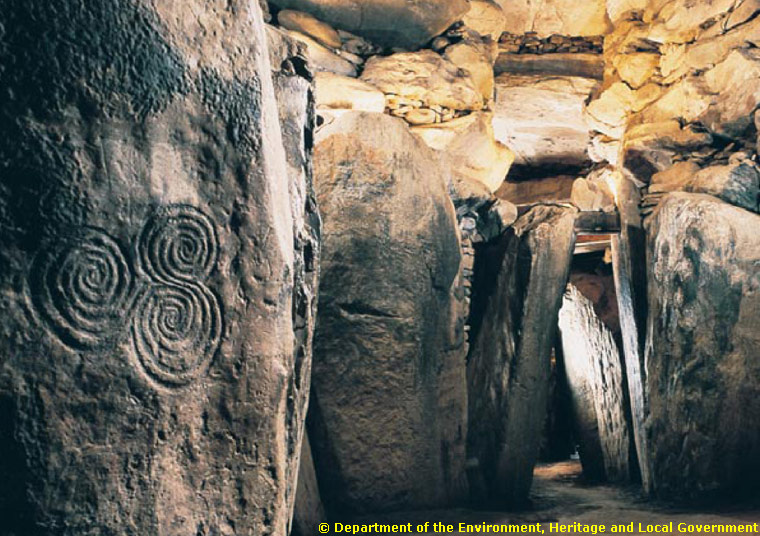
Also, for the fans of Celtic art out there - the Tri-Spiral you see everywhere? This is where the original is. Yup.
 |
| This is quite obviously not my own photograph, as picture-taking inside the monument is strictly forbidden. This picture is from the Newgrange website, so please don't sue me. Also, it's clearly written in bold, yellow Arial across the bottom of the picture. ;) |
After the light demonstration, we were sent back outside so the other half of the group could come in, as we didn't all fit at once. The chamber is quite small - my lecturer estimates about ten people could move comfortably inside at a time, so when 15-20 of us tried to jam ourselves in and look around, it was a tad beyond cozy.
My flatmate and I proceeded to walk around the monument, and yes, remove our shoes to feel the grass and earth on the soles of our feet. As my flatmate says: "It doesn't count if you didn't go barefoot".
 |
I really don't think this photograph requires an explanation.
I wear rings on my toes. My flatmate doesn't. That's all you're getting. ;)
|
 |
| On the way to the bus, an apple in one hand and a book in the other. Classic. |
 |
| The breathtaking view from the site. The weather was glorious once again - a perfect autumn day. |
 |
Brú na Bόinne from a distance - from this far away, it honestly just looks like a mound with a wall. The important thing to remember here is that the wall probably doesn't look a thing like it used to, as it was restored/recreated. All the same stones, just probably not how they were originally placed.
|
 |
| The entrance to the passage. |
 |
| This is one of the two best decorated stones, and it's protected by gates as well as two staircases for tourists to use - normally people would have to climb around the stones to get in, but they try to avoid that now. It's right at the entrance, and you can see just how massive it is by the guy standing right beside it. Amazing. |
 |
| More of the view! |
 |
| This is the rock exactly opposite the entrance stone, intricately decorated and still magnificent after all these years. |
 |
| The outside of the monument. |
After Brú na Bόinne, we hopped another shuttle bus which took us to Knowth, a site not far from Newgrange consisting of multiple burial mounds of different shapes and sizes. My Ancient Celts lecturer actually gave the tour this time, so it was lovely to hear all the tales and theories straight from an expert.
 |
| Multiple burial mounds. Almost looks like Hobbiton, but on that note, a particularly morbid Hobbiton. |


 |
| The entrance to the Knowth main burial mound. The white rocks on the ground are the same as the ones on the facade of Newgrange, but these were left intact after they fell from the mound. You can see by the entrance just how massive these mounds are. Unfortunately we couldn't take photos inside... |
 |
| The stunning views! |
 |
| On top of the largest mound at Knowth. |
 |
| View from the top of the mound. |
 |
| It's these photos that show off just how massive these mounds are. Unfortunately the inside is blocked and we don't have access to very much, but we used a torch to see a little ways inside - "impressive" is an understatement. |
 |
| The decorated rocks on the outside. |
 |
| A few of us crawled through this passage, with help from my lecturer's trusty torch (which was more like an epileptic seizure-inducing strobe to be honest, but meh). It was good fun, and I managed to not get muddy ;) |
After Knowth, we went to Dowth, which has been left intact in terms of restoration. It has been mutilated - some people dug into it some time ago, but apart from that there isn't much to see, which makes it all the more mysterious, knowing what is inside but being unable to actually see it with your own eyes.
It was fascinating to be able to see all three sites consecutively in one day. Brú na Bόinne, the excessively restored, tourist-attracting mound, Knowth, the less reconstructed but still very much protected group of mounds, and Dowth, the untouched mound, whose appearance is a product of time and nothing else.
Two of my classes deal with Irish mythology and stories, and Brú na Bόinne is a very important location in more than just a few of these mythological tales. Characters are born and die here. Lovers elope here. It was an odd feeling to stand on soil that is prominently mentioned in myth - as if the mists were rising and I'd stumbled into the Otherworld.


No comments:
Post a Comment